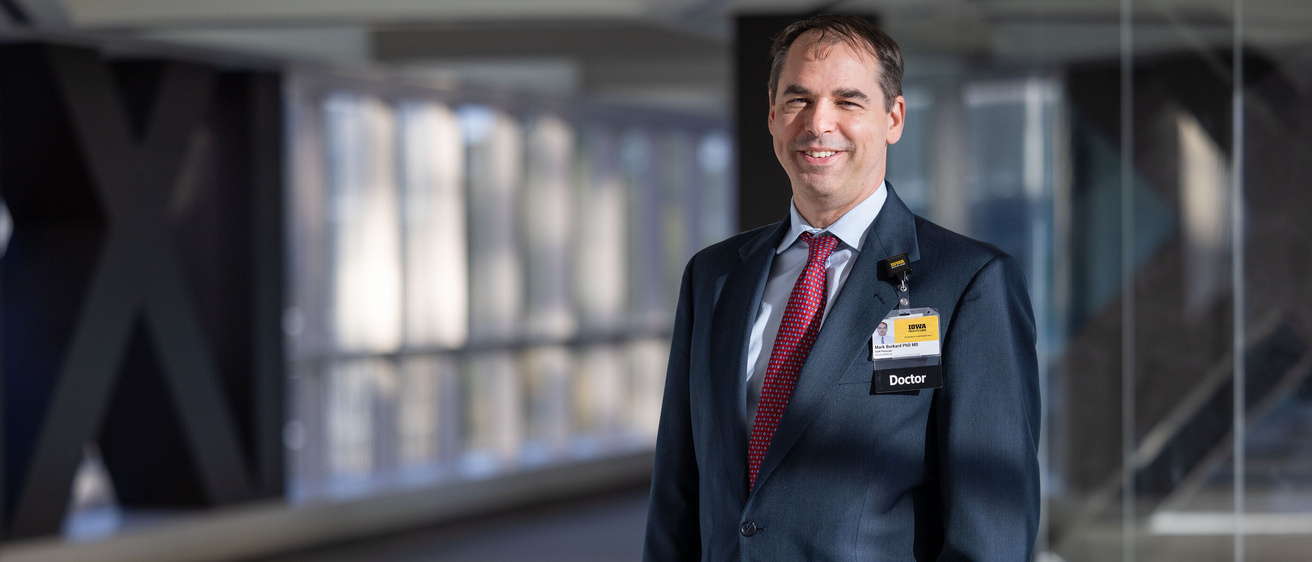
Mark Burkard, MD, PhD, is building on decades of progress in cancer research to bring together innovation and statewide expertise to change what’s possible for Iowans facing cancer.
Oct. 27, 2026
A cancer diagnosis can bring a flood of questions: What treatment is right for me? Where can I find the expertise I need? Are there new options available?
Mark Burkard, MD, PhD, wants Iowans to have the answers, and to have them close to home.
Since becoming director of University of Iowa Health Care Holden Comprehensive Cancer Center in 2024, Burkard has brought a broader vision to those questions, drawing on his expertise in precision oncology, breast cancer research, and experience running statewide programs.
His mission is ambitious and direct: to defeat cancer.
And his work has taken on new urgency as Iowa's cancer rates have risen significantly in recent years, placing the state among the highest in the nation. Burkard sees that reality not as a statistic, but as a call to action.
“As cancer becomes more complicated and specialized, it’s critical we have deep expertise in the state and dedicated methods of sharing knowledge,” Burkard says.
Prior to joining UI Health Care, Burkard spent 16 years at the University of Wisconsin-Madison where he served as a physician-scientist and precision oncology leader. There, he led a statewide program building systems needed to use genetic information in research and patient care. He oversaw clinical trials for rare genetic findings that could be used to help patients and partnered with health systems across the state to connect them with patients.
Drawing on those experiences, Burkard now leads Holden’s comprehensive efforts to address cancer in Iowa through prevention, screening, treatment, research, and education. He is championing efforts to expand access for patients statewide to get care close to home when possible and expedited access to specialists when needed.
Steady progress leads to big breakthroughs
As the only academic medical cancer center in the state, UI Health Care and the Holden Comprehensive Cancer Center are at the forefront of cancer research leading to breakthroughs in treatments and technologies that can treat cancer more effectively.
- One highly promising technology is theranostics. Theranostics combines imaging and treatment, so physicians can see whether therapy is likely to reach tumor cells before treatment even begins. With theranostics, treatment drugs are designed to seek out a specific target on the tumor and deliver radiation precisely to it, without damaging the healthy tissue that surrounds it. Theranostics has been most commonly used for thyroid and prostate cancers, and neuroendocrine tumors. Researchers are now studying how theranostics may be used in other cancers, including pancreatic cancer, breast cancer, lung cancer, melanoma, and others.
- UI Health Care researchers have also played significant roles in recent advancements in metastatic melanoma. In early August 2026, the U.S. Food and Drug Administration granted accelerated approval to TUDRIQUEV™ in combination with nivolumab for advanced melanoma. The treatment uses a new approach to stimulate the immune system with a virus injected into tumors directly, breaking apart the tumor cells while expressing a protein that acts as a beacon for immune cells.
- In January 2026, UI Health Care began treating its first patient with T-cell receptor therapy, an innovative treatment that uses the body’s own immune system to fight synovial sarcoma — a rare and aggressive cancer. This cellular therapy, called afamitresgene autoleucel, or afami-cel (Tecelra), is the first FDA-approved T-cell receptor (TCR) therapy for cancer, and the first drug approved specifically for synovial sarcoma. UI Health Care was a participating medical center in the national clinical trial. Holden offers access to the most advanced treatment options for synovial sarcoma and is also home to some of the nation’s only oncologists who specialize in sarcomas — three of the 70 specialists nationwide work at Holden.
These are just a few of many examples that demonstrate the strength and scope of successful studies where UI Health Care has had an impact.
Looking ahead, Burkard is particularly excited about minimal residual disease (MRD) testing, ultrasensitive blood tests that can detect tiny amounts of cancer DNA after treatment. The tests may help clinicians determine whether cancer is gone or remains behind after surgery. This information will allow follow-up treatment to be tailored more precisely to people who need them. Burkard says Iowa intends to be among the first to run clinical trials and national research projects to evaluate the clinical benefit of ultrasensitive MRD tests in patients with different types of cancer.
“Day to day, working in a lab, it can feel like things take a long time to come to fruition. But if you look at the 50-plus years since the National Cancer Act was passed, steady progress has been made,” Burkard says. “The progress is never as fast as we want, but the continual progress gives me a lot of hope and excitement about the future.”
"I remain optimistic by working alongside a team of experts deeply committed to changing the future of cancer care, and by seeing something larger at work as we all come together."
Keeping care close to home
UI Health Care and Burkard share a vision for a statewide network where oncologists, academic specialists, researchers, and local hospitals collaborate to share knowledge through education, clinical trials, and integrated systems. Tumor boards – multidisciplinary teams of health care specialists and providers who meet regularly to discuss new and complex cancer cases – are another collaborative way for teams to share knowledge and data in real time about patient cases.
This is especially critical for a community-based oncology practice like Mission Cancer + Blood. Located in central Iowa, Mission joined forces with UI Health Care in late 2024.
For Iowa patients, the impact is straightforward: greater access to expertise, advanced treatments, coordinated care, and clinical trials closer to home. Mission care teams have been integrated into key knowledge-sharing pathways, such as shared medical records, tumor boards, and a growing joint clinical trials program that allows patients access to the latest treatments.
Burkard wants all patients to receive highly specialized care when they need it while continuing as much of their treatment as possible in their home communities.
“As oncologists, we cannot work on an island; we talk to each other every day to gain insights and expertise,” Burkard says. “With the shared medical record system across our practice, it’s very easy to send a colleague a link to the patient’s chart, get advice, and collaborate so that every patient gets the best knowledge from the whole team.”
A simple but powerful mission
When considering UI Health Care, Burkard was intrigued by the parallels to his earlier work and saw the opportunity as a rare alignment of mission and expertise in a cancer center positioned to improve care across an entire state.
“I’m excited to be part of a nationally recognized program with a 25-year history as a National Cancer Institute-designated comprehensive cancer center,” Burkard says. “I remain optimistic by working alongside a team of experts deeply committed to changing the future of cancer care, and by seeing something larger at work as we all come together.”
For Iowa's leading cancer center, and for the people it serves, that belief is shaping a future in which world-class cancer care is not limited by geography. It is shared across communities, connected through expertise, and driven by a simple but powerful mission: defeat cancer.
Creating energy and momentum through teamwork
Mark Burkard, MD, PhD, is motivated by hope and driven by the opportunity to be a part of a large, cohesive team of experts dedicated to fighting the war on cancer.
“What we discover in the lab may take a decade or two to advance to the clinic,” Burkard says. “It takes a sustained team effort to get to the breakthroughs, and I believe that more progress is made together rather than alone.”
Since arriving at UI Health Care, Burkard has prioritized recruiting exceptional talent across cancer medicine and research. New faculty members have brought expertise in immunology, cancer genomics, artificial intelligence (AI)-designed therapeutics, drug development, and translational science, creating new energy and momentum across Holden.
“With the solid foundation of outstanding clinicians and researchers at Holden, and with the addition of new talent, there is a remarkable vitality to our cancer research group,” Burkard says. “We have an extremely knowledgeable team of doctors, each with a specific expertise, pushing the cutting edge in research.”
Connecting beyond treatments and research
Recognizing that his focus for Holden extends beyond treatments and research, there are many other connection points throughout the state that Mark Burkard, MD, PhD, champions. A few examples:
- The Iowa Cancer Consortium’s Cancer in Iowa: 99 Counties Project, led by Mary Charlton, PhD, professor of epidemiology at the University of Iowa College of Public Health, and director and investigator at the Iowa Cancer Registry. Through this multi-year project, Charlton and her team are presenting county-level data to each of the 99 counties in Iowa to help those residents understand the risk factors in their area, and what they can do to impact those risk factors. The project has spurred awareness and action among communities to tackle rising cancer rates.
- The Holden Community Outreach and Education (COE) program, under the leadership of Natoshia Askelson, MPH, PhD, associate director, Community Outreach and Engagement, brings together Holden researchers and Iowans to improve cancer research efforts. Among many other activities, one example is Askelson’s team assembled a blue-ribbon panel of experts from outside Iowa to virtually review Iowa’s data and gave advice on research and interventions to reverse the trends of cancer rates.
- UI Health Care is also collaborating with the Iowa Department of Health and Human Services on their rural transformation project. The Combat Cancer Technical Assistance program, co-led by the UI College of Public Health and UI Health Care, will support development of a coordinated, statewide cancer ecosystem that improves early detection, strengthens rural partnerships, and supports access to cancer care across Iowa. This expands UI Health Care’s existing work supporting hospitals across the state through the I-CAN network and county-level prevention initiatives through the University of Iowa Cancer Partnership.